Can Your Brand Be Registered as a Trade Mark? A Practical Guide for Businesses
Choosing a name, logo, or brand identity is one of the most important steps in building a business. It is how customers recognise you, remember you, and distinguish your goods or services from those of your competitors. However, not every name, logo, slogan, colour, or design can be registered as a trade mark.
Before investing in branding, packaging, advertising, a website, or a product launch, business owners should consider whether their chosen brand can actually be protected. A brand may look attractive from a marketing perspective, but that does not automatically mean it is registrable as a trade mark.
This is where early trade mark advice can make a significant commercial difference. Do you need help with registering a trade mark, or are you involved in a trade mark dispute? Book a Free Consultation Call by calling 0208 185 0990.
What can be registered as a trade mark?
A trade mark is a sign that helps customers identify the goods or services of one business and distinguish them from those of another.In simple terms, it is a badge of origin. It tells the public who is responsible for a product or service.
A trade mark can include:
- a business name;
- a product name;
- a logo;
- a slogan;
- a word or phrase;
- letters or numbers;
- a colour or combination of colours;
- a sound;
- the shape of goods or packaging; or
- a combination of these elements.
For example, a restaurant name, a clothing brand logo, a skincare product name, a software platform name, or a distinctive packaging design may all potentially function as trade marks.
The key question is whether the sign is capable of distinguishing your goods or services from those of other businesses.
The importance of distinctiveness in a registered trade mark
To be registered, a trade mark must usually be distinctive. This means that the public must be able to recognise the mark as identifying your business, rather than simply describing the goods or services you provide.
For example, a business selling candles may struggle to register a name such as “Luxury Scented Candles” for candles, because the words simply describe the product. Other traders should remain free to use ordinary descriptive words to describe their own goods.
By contrast, a made-up word, an unusual name, or a distinctive logo is more likely to be registrable because it is more capable of identifying one particular business. As a general rule, the more distinctive the brand, the stronger the protection is likely to be.
What cannot usually be registered?
A trade mark application may be refused if the mark does not meet the legal requirements for registration. Common problems include the following.
- The mark is descriptive
- A mark may be refused if it simply describes the goods or services.
- For example, words that describe the kind, quality, purpose, value, geographical origin, or other characteristics of the goods or services may be difficult to register.
- A name such as “Fresh Bread” for a bakery or “Fast Accounting” for accounting services may be problematic because it tells the customer what the business does, rather than identifying a distinctive commercial source.
- The mark is too generic or common
- A trade mark may also be refused if it is made up of words or signs that have become customary in the relevant trade.
- If customers would see the words as ordinary trade language rather than as a brand, the mark may not be registrable.
- The mark is misleading
- A trade mark should not mislead the public.
- For example, a business should be careful about using words that suggest goods are organic, handmade, British-made, specialist, certified, or connected with a particular place if that is not accurate.
- A misleading mark may face objection.
- The mark is offensive or contrary to public policy
- Marks that are offensive, seriously objectionable, or contrary to public policy may be refused.
- This is particularly relevant where a business chooses a provocative name or slogan for marketing reasons. A memorable brand is useful, but it still needs to be legally registrable.
- The mark is too similar to an earlier trade mark
- Even if a mark is distinctive, it may still face difficulty if someone else already owns the same or a similar trade mark for the same or similar goods or services.
How similar is similar for a registered trade mark?
One of the most common questions business owners ask is: how similar does another brand need to be before it becomes a legal problem? The answer is not always straightforward.
Trade mark law does not only look at whether two marks are identical. It also considers whether they are sufficiently similar to create a likelihood of confusion, or, in some cases, whether one business is taking unfair advantage of another brand’s reputation.
- A useful example is the High Court case of Jack Wills Ltd v House of Fraser (Stores) Ltd.
- Jack Wills owned trade marks for its well-known pheasant logo, which was used on clothing. House of Fraser used a pigeon logo on clothing sold under its own brand.
- The logos were not identical. One was a pheasant and the other was a pigeon. However, both involved a silhouette-style bird facing in a similar direction, used in a similar commercial context, namely fashion and clothing.
- The court found that the House of Fraser logo infringed Jack Wills’ trade mark.
- This case is a useful reminder that small differences may not be enough if the overall impression remains similar. A business cannot assume that changing one element of a logo, animal, shape, or image will automatically avoid infringement.
- Examples in the case:


- The practical lesson is clear. When comparing two marks, the court will not conduct a side-by-side exercise focused solely on differences. It will consider the overall impression on the average consumer.
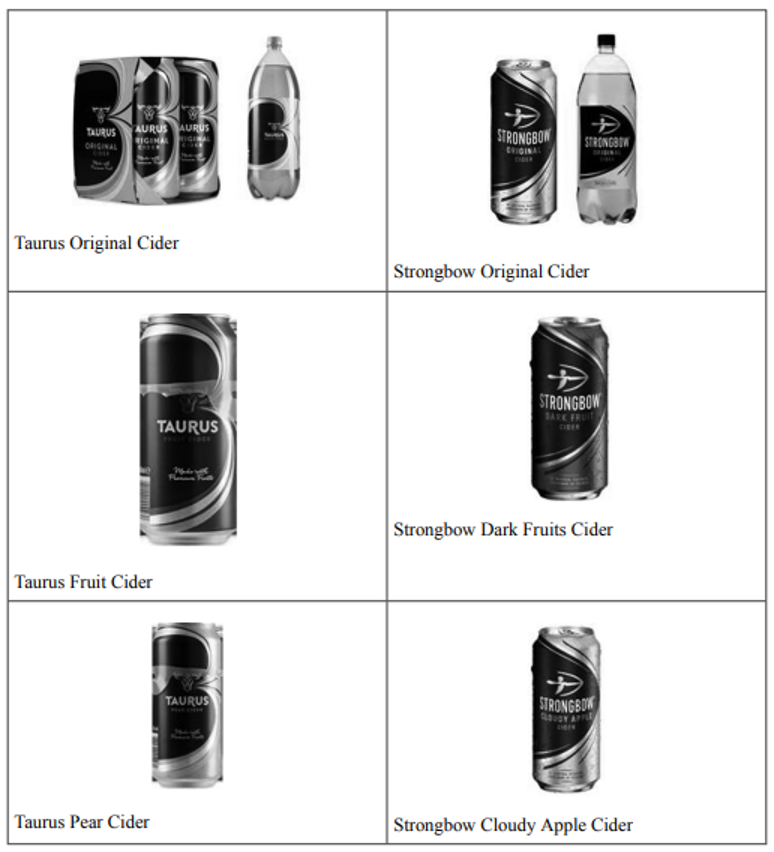
- A more recent example is the Court of Appeal case of Thatchers Cider Co Ltd v Aldi Stores Ltd.
- Thatchers sold a cloudy lemon cider product with distinctive packaging. Aldi later sold its own Taurus cloudy lemon cider. The products were sold under different names, but the issue concerned the packaging’s overall appearance and presentation.
- The Court of Appeal found that Aldi’s packaging took unfair advantage of the reputation of Thatchers’ trade mark.
- Importantly, the court did not need to find that customers thought the Aldi product was actually made by Thatchers. The issue was not simply direct confusion. The court considered whether Aldi’s packaging reminded consumers of Thatchers’ product and whether Aldi benefited from that association.
- The court concluded that Aldi had intended its product to remind consumers of Thatchers’ product, effectively conveying that the Aldi product was like the Thatchers product, but cheaper.
- Examples in the case:
This is important for businesses because it shows that trade mark infringement is not limited to obvious copying. A business may face risk where it adopts packaging, colours, layout, imagery, or overall presentation that brings a competitor’s brand to mind.
A strong brand deserves strong protection – Contact Us
You can contact the team at Anwar Legal to discuss starting a trade mark application. To book a Free Consultation Call with Mr Usman Anwar, the Legal Director, or another staff member in the Disputes Department, please complete the Contact Us Form or call 0208 185 0990.
For consumer disputes worth more than £10,000, we offer a number of funding arrangements which are outlined on the following webpage Fixed Legal Costs Litigation.
Still not convinced? Read some of our client’s success stories and testimonials on how they settled their business disputes using our legal service.